

Understanding ONDC: The Future of Digital Commerce

The latest player in a rapidly evolving e-commerce landscape in India has promised to revolutionize the way digital commerce functions. ONDC is the vision of a more equal, transparent, and open network for digital commerce – one that breaks the monopoly of the big e-commerce players and finds a new window opened up for new as well as smaller players. So what exactly is ONDC, and how does it work? How will this impact businesses and consumers? Let’s dive into the exciting world of open digital commerce networks.
Imagine an online shopping world where you can compare prices, services, and products from multiple platforms all in one place. With the ONDC app, that no longer remains a far-fetched dream but is actually being realised. Unlike conventional e-commerce platforms where a few large players dominate, ONDC creates an open network that allows sellers, buyers, and service providers to connect directly, regardless of the platform they use.
What is ONDC?
The Open Network for Digital Commerce is initiated by the Government of India to introduce an open protocol applicable to all e-commerce platforms to enable smooth interaction among them. It aims to democratise the space in digital commerce by providing an open e-commerce network that would allow buyers and sellers to interact with each other across different platforms. It decreases the dominance of a few large e-commerce companies and increases the opportunities for equal competition to be nurtured with smaller businesses and start-ups.
One can really see it as an accessible, connected platform for e-commerce and just like UPI changes the digital payments ecosystem, a new change is all set to emerge with ONDC, promising to free online shopping for once again not only the consumers but also the businesses from unfair competition and lack of innovation.
Rise of the ONDC: Why Now?
The development of ONDC comes at such a time when global and Indian e-commerce markets are dominated by a few majors.
Here, large platforms set the rules of the game, creating quite a reverse Rosencrantz effect for smaller businesses, thereby raising questions about monopolies, data ownership, and unfair trade practices, prompting the Indian government to find ways.
Started in July 2021 with the formation of ONDC by DPIIT, a nodal ministry at the Department of Commerce and Industry in the government, the primary aim was to make the digital marketplace transparent, fair, and inclusive. It eventually attracted a consortium of private sector companies as its backer, who rapidly expanded it across many sectors-from retail and ONDC food delivery to health care, fintech, and more.
Since its inception, ONDC has already connected more than 370,000 vendors across 588 cities, with major open network for digital commerce apps like Flipkart, Paytm, Amazon, and PhonePe’s Pincode already on board. To date, millions of orders have been processed through the ONDC network and are quickly becoming a part of India’s digital commerce ecosystem.

How does ONDC work?
In understanding how ONDC works, one first needs to appreciate the very heart of its core purpose : creating a decentralized, open e-commerce network where sellers and buyers will be able to communicate and engage with one another across disparate platforms.
This is in stark contrast to how Amazon or Flipkart is structured as a traditional e-commerce model that uses centralized platforms, while ONDC utilizes a decentralized, open protocol for the free flow of communication between different platforms. Consequently, this means that the competition and innovation in the marketplace will be brought to a more level playing field.
The ONDC platform is not an app or website. ONDC is more of an infrastructure where different types of platforms and service providers can interconnect using predefined specific protocols. Think of ONDC as the “backend” that facilitates transactions, interactions, and data exchange between apps and services that makes e-commerce more accessible and inclusive.
Let’s break down how ONDC works and its components that make it functional as an open commerce network.
- Buyer Apps: Interfaces for consumers to browse, compare, and make purchases on any of these platforms. It aggregates products from multiple sellers’ various sources, providing the buyer with more choices and better prices.
- Seller Apps: It is the network where the seller can list products, receive and deliver orders and manage inventory. With being in the ONDC, a seller can expand its audience not confined to one platform alone.
- ONDC Gateways: Intermediaries that are used in facilitating transaction communications, interactions between the buyer and the seller. The gateways assist in providing frictionless transactions, aggregating product catalogues, matching orders, and management of transactions among others.
The Beckn Protocol
- It is the backbone of ONDC that provides standardised guidelines for interoperability between various platforms and services.
- It helps realise greater transparency because it reduces the dependence on centralised intermediaries. In addition, security increases as the power to transactions and data disperses throughout the network, making it tougher for malicious actors to breach the system.
- The ONDC network ensures scalability by allowing an increasing number of participants without compromising performance.
Microservices Architecture
- It splits the ONDC system into smaller, independent services that can still talk to each other through APIs.
- It enables flexibility since different services can be designed and improved one at a time without affecting the network in the broad scheme of things.
- Improves scalability whereby, when more participants join, the network does not sacrifice performance.
Decentralisation
- This gives equal chance to participants to participate in electronic commerce.
- It eliminates the practices of monopolies since businesses of all sizes can have an opportunity to compete fairly.
- It enhances security by distributing transactions and data throughout the network, hence increasing the difficulties through malicious actors to compromise the system.
ONDC and the Rise of Quick Commerce
The one space in which ONDC has already started to create waves is quick commerce. Quick commerce refers to fast, on-demand delivery of goods, usually within 30 minutes. The food delivery business of the ONDC, for instance, will be a game-changer for those local restaurants and the associated delivery services in this market by providing them the advantage to engage with the giants like Zomato and Swiggy through a huge reduction in their commissions.
Since the model is removing intermediaries and offering direct access between sellers and buyers, faster services at cheaper prices can be provided by businesses. This also accelerates the growth of small businesses while consumers get faster and cheaper service.
ONDC Business Model Benefits for Businesses and Consumers
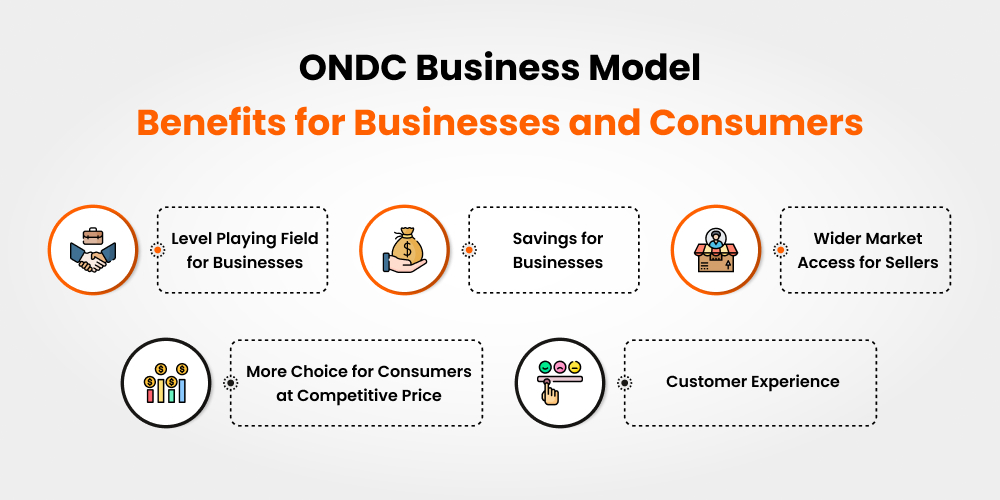
The ONDC business model has a number of benefits for businesses and consumers.
Level Playing Field for Businesses:
ONDC ensures that all businesses, no matter the size, can counter the clout of major e-commerce companies. This gives small and medium enterprises an upper hand in competing with others, thus increasing their market reach without hefty fees.
Savings for Businesses:
ONDC does not charge heavy commission fees and platform charges. Therefore, on sundries, the seller keeps a much higher proportion of their earnings. The cost saving in the process is passed back to businesses in the form of increased profitability and then lower prices to consumers.
Wider Market Access for Sellers:
Sellers will have wider market access through listing on different buyer apps and platforms within the ONDC network. Of course, this now expands markets for them, including previously underserved ones and international growth as well.
More Choice for Consumers at Competitive Price:
With the increase in consumer choice and competitive pricing, it allows consumers to compare the offers made by different sellers. Shopping becomes diversified and economical.
Customer Experience:
ONDC improves the customer shopping experience by integrating the products of various sellers on a single platform, enabling faster delivery and quality customer care and more transparency and truthfulness in the transaction process.
Challenges in Implementing ONDC
Although the potential benefits associated with ONDC are numerous, there are challenges facing its implementation. Switching from a closed and centralised system to an open and decentralised network entails complexity in technology, logistics, and governance.
- Technical Complexity: It would require technical skills for the integration with the ONDC for smaller firms. They lack the same. Building APIs with multiple platforms and ensuring interoperability involves a highly complicated process.
- Standardisation: For providing a seamless experience to users, creating uniform standards in the network is very essential. It involves achieving consensus across various stakeholders-from big companies to small businesses.
- Data Security: An open system also contains data security issues. There should be appropriate measures to protect such sensitive business and consumer data from breach.
Role of ONDC in Empowering Local Businesses
Democratising e-commerce and giving a level-playing field to local businesses is part of the guiding principles of ONDC. Today, small retailers often find themselves off their game while competing against huge e-commerce companies dominating online markets.
However, this will not be possible with ONDC, opening an e-commerce network wherein even the smallest of vendors can list up their products and reach consumers across the country.
An artisanal shop in a small town can now reach out to customers in major cities without larger players overtaking it. This is a revolution in itself for India’s SME sector and development of local economies.
Future Powered by ONDC
The future for Indian digital commerce seems bright, more so with ONDC as the leading player. The more businesses and sectors join in, the more its ripple effects will begin to show true strength in this network-how inclusive, transparent, and competitive a marketplace can truly be.
Consumers who demand a frictionless shopping experience directly linked to the best services of multiple providers will switch towards the ONDC app.
Another development point that suggests further diversification toward a more differentiated digital economy is the growth of ONDC food delivery, quick commerce, and local retail integration. Innovations will evolve in how shopping, selling, and online interactions play out, powered by openness and interoperability.
Once the ONDC platform expands, it will spur innovation, create employment, and unlock new opportunities for small, medium, and large businesses.
Conclusion
ONDC is much more than just a new technology- it represents the future of a fairer, more accessible ecosystem for e-commerce.
Ahead lies only brightness for digital commerce in India, and Lokaly is leading from the front in this exciting change. Ready to ride the next wave of digital commerce? See how Lokaly will unlock the power of ONDC for you today!
FAQs
Related Blogs
-

29 September 2025
Proven Ways to Simplify Your B2B Order Management

